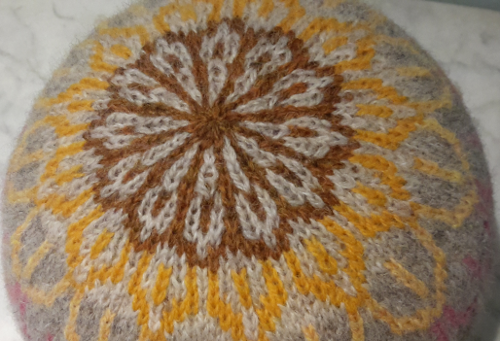
Lughnasadh

Lughnasadh is the seventh and penultimate festival in the Wheel of the Year. It falls on 1st August, and is also know as Lammas. The first harvests have been gathered in: the flax crop, the early grains, soft fruits like blackcurrants and raspberries. Time to celebrate the bounty. The year is beginning to wane, we are halfway between Litha/midsummer and Mabon/equinox. The days are still warm but shorter, evenings a little cooler.

The light fingering sample in green and gold long colour-change yarn took one 100g ball of Schoppel Wolle Zauberball, colourway Zauberwald.

Lughnasadh the shawl is an asymmetrical triangle with a memorable all-over lace pattern, knit on the bias from the pointy end, gradually increasing in width. It can be knit in any lightweight yarn, to any size, with a choice of two grounds, garter or stocking stitch/stockinette; and two cast offs, standard stretchy or crochet chain cast off.

The golden yellow sample below was knit in Eden Cottage Milburn 4ply in colourway Harvest Gold. It took 146 g / 584 m / 639 yds or just under balls of yarn.

This shawl can be made to any size. Finished sizes of the samples shown are:
Light Fingering: 226 cm/90 ½” length along longest edge x 95 cm / 38” deep at its widest point.
4ply/fingering: 248 cm/99 ¼” length along longest edge x 117 cm / 46 ¾” deep at its widest point.

This pattern has both charts and written instructions. It has been thoroughly professionally tech edited, but has not been test knit except by me. Full pattern support is available by email.

Lughnasadh is available in both the Ravelry Granary Knits Store and the Payhip Granary Knits Store.

Intarsia: twisting the colours

Intarsia is a visually striking knitted fabric, with large blocks of colour or complex patterns not possible using stranded methods. Intarsia pattern instructions usually tell the knitter to twist the colours together, but don’t really specify how to do this to achieve a neat effect. I have found that just holding the two yarns in a particular way allows them to naturally lock together forming a line on the reverse of the fabric, without bumps or exaggerated twists. This is intuitive and quickly becomes a natural way of working.

The join between two colours shown on the reverse
The join when viewed from the front

This is how I do it.

Stocking Stitch Colour Joining

Work to the point at which the colours are to be joined, in this case, the join is a straight line
Hold the yarn you have been working with out of the way, and bring the new colour under the old. Here, the old colour is green (on the left) and the new colour is orange (on the right).
The view at the back of the work, old colour above, new colour coming from the right and below.
Start working with the new colour (orange).
The back view at this stage
Having purled back to the point of the join, this is what it looks like
After a few rows, the back of the piece shows the neat pattern of the join
The join front view

Garter Colour Join

The method here is the same as for stocking stitch at the front of the work, but for the back of the piece it is a little more complicated.

The back of the piece, the orange has been kit to the join, the orange yarn is still at the front of the piece
Bring the “old” working yarn through the gap to the back of the piece; “new” working yarn is the green below the orange
Holding the old orange to the left, bring the new green under and up
Pass the new green to the front of the piece over the old orange and adjust tension
Knitting with the new green yarn
The view of the back, showing the pattern for both stocking stitch joins and garter stitch joins are the same
The view of the front of the piece

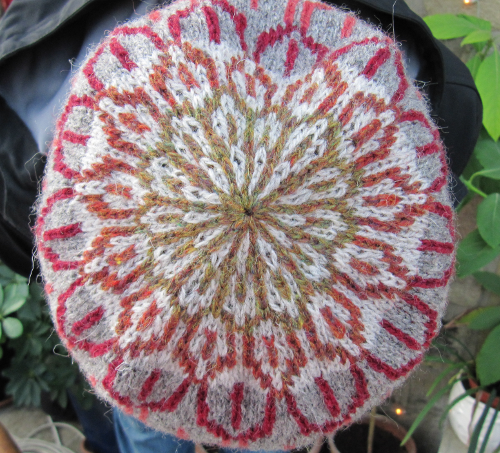
Feather Cap Beanie Pattern Released!

The Feather Cap Beanie pattern is now available from the Granary Knits Pattern store.

Feather Cap is a stranded knit hat, using ten colours of Jamieson’s of Shetland wonderful pure wool Spindrift yarn. The motif itself and the colours I have chosen reflect the feather patterns and colours of my lovely Cream Legbar chickens: Freddie, Sorrel, Sage, and Lavender. From a distance they look a like a dull brown, but close up, their feathers are a beautiful brown/grey, with touches of cream and pink. The four background colours and six foreground colours reflect this lovely effect.

composite

compositehat

The pattern gives three sizes; teen/small adult, adult, and large adult. In addition to the subdued palette I also provide suggestions for a more brightly coloured palette and for a monochrome colourway in shades of grey.

There are matching mittens (full mitten and fingerless) and a matching cowl, also now available.
https://www.ravelry.com/patterns/library/feather-cap-beanie